Friday, June 26, 2026

What to Do With a Paper Doll Collection

Collage of vintage, contemporary, and international paper doll books for the blog article "What to Do With a Paper Doll Collection."

What to Do With a Paper Doll Collection

Over the years, I’ve been asked this question many times. Sometimes it’s from a collector who is downsizing. Sometimes it’s from a family member sorting through a loved one’s belongings. And occasionally it’s from someone who simply wonders what will happen to their collection someday.

Unfortunately, there is no simple answer.

Unlike some collectibles, there is no central paper doll brokerage service waiting to step in and handle everything. Finding the right solution usually takes some research, some legwork, and a lot of patience. Every collection is different, and every collector’s priorities are different.

Before making any decisions, I encourage people to ask themselves a simple question: What matters most?

Are you hoping to maximize financial return? Find appreciative new owners? Keep the collection within the paper doll community? Preserve historically important material? Clear space quickly and efficiently? Honor the memory of a loved one?

There are no wrong answers. In fact, many people find themselves balancing several of these goals at once. Understanding what matters most will help determine the best path forward.

Before selling, donating, or giving anything away, spend a little time getting familiar with the collection. You don’t need a detailed inventory, but it helps to know what you’re dealing with. What era are the paper dolls from? Early antiques (late 1800s-1920s), mid-century (1930s-1960s), late 20th century (1970s-1990s) or contemporary (2000s-today)? If they are books, are the cut or uncut? Are they loose sheets cut or torn from magazines? Are they artist self-published sets? Or perhaps convention souvenirs, reference books or other related paper ephemera?

Take photographs. Make a few notes. Set aside anything that seems especially important. You may discover that some items deserve special consideration while others can be grouped together.

And if you’re dealing with a loved one’s collection, don’t feel pressured to make immediate decisions. Sometimes the best thing you can do is put the boxes in a safe place and revisit the project several months later. Paper dolls are patient.

Think about keeping a small portion of the collection. A favorite artist, a childhood paper doll, a signed piece, or a memorable convention souvenir may be worth saving. Family members who aren’t collectors themselves often find comfort in keeping a representative handful of items.

A collection doesn’t lose its meaning simply because it becomes smaller.

For those interested in selling, there are several possibilities. Selling paper dolls yourself generally offers the greatest potential financial return. eBay, Etsy, Facebook Marketplace, local on-line sales groups, and collector groups can all be useful tools. The tradeoff, of course, is time. Items need to be identified, photographed, researched, described, priced, packed, and shipped. Depending on the size of the collection, this can become a significant project.

Before pricing anything, spend some time on eBay looking at actual sales rather than asking prices. What people hope to get and what buyers are actually paying can be two very different things. Unfortunately, there is no shortcut. Whether you’re selling paper dolls, books, artwork, or collectibles of any kind, a little research goes a long way.

Some collectors and families decide that convenience is more important than maximizing profit. In those cases, a local collector, antique dealer, auction company, or paper doll enthusiast may be interested in purchasing all or part of the collection. This approach usually requires less work but often results in a much lower financial return. For many families, however, the simplicity is worth the tradeoff.

Auction houses and estate sales agents can also be an option, particularly for collections containing rare or unusual material. Results vary widely, and paper dolls are not always a specialty area, so it’s worth asking questions, understanding fees and commissions, and researching the auction house’s experience with paper dolls and related collectibles before proceeding.

For some collectors, where the collection goes matters. They don’t simply want to sell their paper dolls; they want them to be appreciated, enjoyed and loved.

Collector groups, paper doll events, and hobby organizations can sometimes help connect collections with people who will genuinely enjoy them. There is a certain satisfaction in knowing that favorite pieces will continue to be collected, studied, displayed and loved.

Not every collection needs to be sold. Museums, historical societies, libraries, university special collections, educational institutions and paper doll organizations may all be potential homes for paper doll material. Before donating, contact the organization and discuss the collection. Depending on the size and nature of the donation, there may also be tax considerations. If this is important to you, consult a qualified tax professional or financial advisor before proceeding.

Paper dolls are more than toys or collectibles. They can provide insight into fashion, advertising, pop culture, childhood, gender roles, race, social class, illustration, printing history and changing cultural values. For this reason, many colleges and universities have presented exhibitions, lectures and scholarly research involving paper dolls and related paper ephemera.

I know of a few significant paper doll collections that have found homes in museums and university special collections, where they remain available to researchers and future generations. For collections with strong historical, artistic, or research value, this can be an especially meaningful option.

Over the years, Paperdoll Review has received donations from collectors and their families. Some items become valuable reference material for our magazine. Others help support ongoing projects, including research and preservation efforts. Past Paper Doll Conventions, as well as the Pennsylvania Paper Doll Luncheon, have likewise benefited from donations used for raffles, auctions and other fundraising activities. There are many ways for a collection to continue contributing to the paper doll community.

Some collectors take great comfort in knowing that their paper dolls will continue to educate, inspire and be enjoyed long after they have left their shelves.

One lesson I’ve learned is that every option involves tradeoffs. Generally speaking, the highest financial return requires the most effort. The quickest solution usually brings the lowest return. Preservation and profit do not always go hand in hand.

There is no perfect answer.

The best choice depends on the collection, the circumstances and the goals of the person making the decision.

Paper doll collections are rarely just collections. They can represent years of searching, friendships, discoveries, favorite artists, convention memories and countless hours of enjoyment. Whether a collection is sold, donated, shared with family or passed along to another collector, the goal is not simply to find a way to dispose of it. The goal is to find the choice that feels right for the collection, the circumstances and the people involved. 

If you’ve found an approach that worked well for your own collection or a loved one’s, I’d be glad to hear about it. Every story adds to our shared understanding of how best to care for paper dolls and the memories they hold.


Monday, May 18, 2026

Paperdoll Review Issue 97 - Tea Party Paper Dolls, Hosting Tips, Vintage Fashion & Nostalgia


Let's Have a Paper Doll Tea Party! 

Put the kettle on, pick a paper doll book, grab your scissors, and you're ready to sip, snip and play paper dolls! Our latest issue #97 puts two favorite pastimes together—tea and paper dolls—in one delightful issue. As managing editor, I'm always on the lookout for subjects that could work for our magazine. Some are better suited to a stand-alone article, while others are worth exploring as a main theme throughout the magazine. I've been collecting tea-themed paper dolls for years, and as my collection grew, the idea grew to cover the topic in a variety of ways. So I put the "tea" on the docket and asked my contributors to bring their best ideas to the table.


Goldilocks, Alice in Wonderland, Dionne Quints
Goldilocks, a British 1950 read-and-dress book; Alice in Wonderland, Whitman, 1976; a Shackman reproduction of Cecile from the 1940 Dionne Quints series.

Vintage greeting cards, tea party theme
These tea party greeting cards fall into the paper toy category, with props to punch out and insert into scenes.

Martha Raively piped up with a charming idea: an article on tea party tips. As a retired librarian, she loved the idea of diving into old etiquette books and comparing their advice to today’s tips for hosting a cozy tea. For visuals, I decided to focus on paper dolls that specifically depict a tea party, including several charming book covers and vintage greeting cards that invite you right into the scene.

Tea Gowns, Dress-a-Doll, British Tea
Tea Gowns, Jenny's Tea Party Dress-a-Doll, Brits & Their Tea


More ideas bubbled up among our contributors. Fashion historian Brenda Sneathen Mattox covered elegant tea gowns, while my co-editor Lorna Currie Thomopoulos explored the rich traditions of the British tea culture. 

For our dress-a-doll feature, the subject is yours truly! Starting with a paper doll drawn by David Wolfe a birthday gift, we asked readers to create costumes to fit the tea party theme of their choice. I was tickled pink to see all the clever, pretty costumes that came in. Shown above is one of the 6 dress-a-doll pages displayed throughout the magazine. 

Mod Paper Doll by Bruce Patrick Jones, Coca-Cola Pants

As if there weren't already enough "Jenny" in the issue, Bruce Patrick Jones surprised me with a new paper doll called "Jenny á la Mod" featuring fashions I've really worn at paper doll conventions—including Coca-Cola pants on loan from Bruce himself! He created it for his article on "Paper Dolls of Paper Doll People," and as a bonus, Bruce granted permission to make the paper doll available as a free download! Click here for the link.

This is just a sampling of all the paper doll goodness filling the pages of Paperdoll Review Issue 97. If you love tea parties, vintage fashions and nostalgia, this one's for you! Click here to order Issue 97, or better yet, click here to subscribe so you can enjoy future issues of paper doll fun!


Tuesday, January 20, 2026

Paperdoll Review 2025 Year in Review - All the Pretty Paper Dolls!


Paperdoll Review 2025

Paper Doll Books and Magazines of 2025!

Look at all the fabulous paper doll books and magazines from 2025! None of this would be possible without the talents of our artists, writers, editors and designers—and, of course, all of you wonderful collectors who buy our paper dolls and subscribe to the magazine! Thank you to everyone for keeping us going!

Tom Tierney - Thanks to Tom's niece Kathy O'Tierney, we have two new paper doll books by Tom! Parade of Stars celebrates eight classic stars who had been special guests of Paper Doll events in LA. Cherished characters from Alice in Wonderland and Wizard of Oz are transformed into paper dolls in Tom's Alice and Dorothy.

Julie Allen Matthews illustrated two fun books: Emma McKay Every Day, inspired by classic magazine paper dolls such as Betsy McCall; and A Very Flapper Halloween featuring a flirtatious flapper and her spooktacular fancy dress costumes. 

Ralph Hodgdon entrusted us with a big stack of his original paper doll art in hopes we'd publish new paper doll books. In 2025 we issued Marie Antoinette Vol. 1 and Marion Davies. We hope to offer more books by Ralph in 2026!

Dan DeSantis has become a favorite among collectors. Two books came out in 2025: Madaling and Lockie McLuckie, both inspired by adventurous ladies of the Jazz Age. Coming in 2026: Beverly Bazaar!

Kwei-lin Lum created the most inventive paper doll of all! A to Z Paper Dolls takes you from Apricots to Zodiacs. Isabelle and Chloe model fantastic fashions based on alliterative adages, one for each letter of the alphabet. 

Eileen Rudisill "Rudy" Miller created a classy collection of 20th Century Couture Paper Dolls, showcasing 100 years of fashion, from Worth to Versace. Rudy is already working on two new books for Paperdoll Review. What are the topics? Think tea and princesses!

Inspired by our own girls' camping trip early in 2025, Alina Kolluri dreamed up a camping trip for paper dolls in a most charming book called Glamping with Opal and Briar Lee. Alina also illustrated a paper doll book featuring authentic folk costumes for her favorite storybook character in Red Riding Hood in the Black Forest.

In association with the Deanna Williams estate, we produced another delightful paper doll book by Deanna—Caroline Comes Calling with elegant Victorian era gowns.

Rachel Cohen tapped into the big-eyed doll craze with her Big Eyed Girlies paper doll book, inspired by such dolls as Blythe, Pullip and Rainbow High.

Golly, that's a lot of terrific paper dolls! We also issued a mid-century reproduction called Hisayo-chan’s Dress-up and produced three issues of our Paperdoll Review magazine

There's a whole lot of paper doll image sharing happening all over the Internet, but we need folks to actually buy paper dolls in order to stay in business. We take pride in producing high quality, professionally published books and magazines and hope collectors will continue to shop and new generations will embrace this enriching form of play. Whether you're into fashion, classic film, storybooks, history, nostalgia or kitsch, there's a paper doll for you! Please visit paperdollreview.com and shop for paper dolls!


Friday, November 21, 2025

Jenny's Favorite Paperdoll Review Magazine Issue Soars to New Heights in Sci-Fi Style


paper dolls, paper doll magazine, sci-fi, sci-fi fashion,

My Favorite Paperdoll Review Issue

The comic's Katy Keene by Bill Woggon is featured on the cover of
Paperdoll Review Issue 95 (2025)

As I enter my 35th year of publishing paper doll magazines, I must confess that I've said "This issue is my favorite" upon publication of every single issue. The pride and joy is palpable as I flip through a copy of the magazine fresh from the printer. Though I have a hand in every square inch of its 48 pages, I couldn't do it without the many wonderful folks who provide art and articles and assistance with design, editing, proofreading, suggestions, and so on. Our printer does a fantastic job, too!

Here's what's different about this "most favorite issue." The overall theme is Sci-Fi Style—and the thing is, I am not at all a sci-fi fan. I have no interest in sci-fi movies, TV shows or comic books. I've never been to a comic-con and I know nothing of the Marvel Universe. But here's what I do like: fashion and paper dolls. Add sci-fi to the mix and we've got a colorful, creative array of paper dolls to enjoy! I may not like sci-fi, but I sure like sci-fi style!

paper dolls, sci-fi, fantastic fashions
ci-Fi Style Dress-a-Doll pages from Paperdoll Review Issue 95
Doll by Kwei-lin Lum, costumes by our readers

 
I super enjoyed seeing the creative costumes come in for our dress-a-doll as well as the wild and wacky paper dolls submitted by artists. The stellar design on the front cover is from a vintage 1963 Katy Keene Comic by Bill Woggon. Though she's not a sci-fi girl, Katy imagined many out-of-this world scenarios including a honeymoon in space.

Iconic Sci-Fi Characters, our lead article by Kwei-lin Lum

Kwei-lin Lum has the coolest paper doll collection of anyone I know, and she graciously offered to cover Iconic Science Fiction Characters in her feature article which includes Buck Rogers, Flash Gordon, Superman, Captain Marvel, The Jetsons, Captain Scarlet and the Mysterons, and many more. 


Steampunk Style
Steampunk Style article by Lorna C. Thomopoulos

My favorite article is Lorna's piece on Steampunk Style. The super cool paper dolls shown here are by Sandra Vanderpool. Sandy and her BFF Bev Micucci created altered books centered around the paper doll. The costumes are designed to be removed from each page to dress on the doll. 

We couldn't do a Sci-Fi issue without including Star Trek! So our resident Trekkie, Tracy Williams, takes us into the world of Star Trek Fandom. And to round out the issue, we have two non-theme articles: Listen & Play Paper Dolls and a Ginghams Paper Doll Mystery. Click here to order the issue or better yet, subscribe to our magazine!

 Soon I will begin work on the next issue, which is sure to become my favorite.

Friday, July 11, 2025

The Best Paper Doll Ever? A Stellar Creation by Bruce Patrick Jones for our Summer Fun Issue

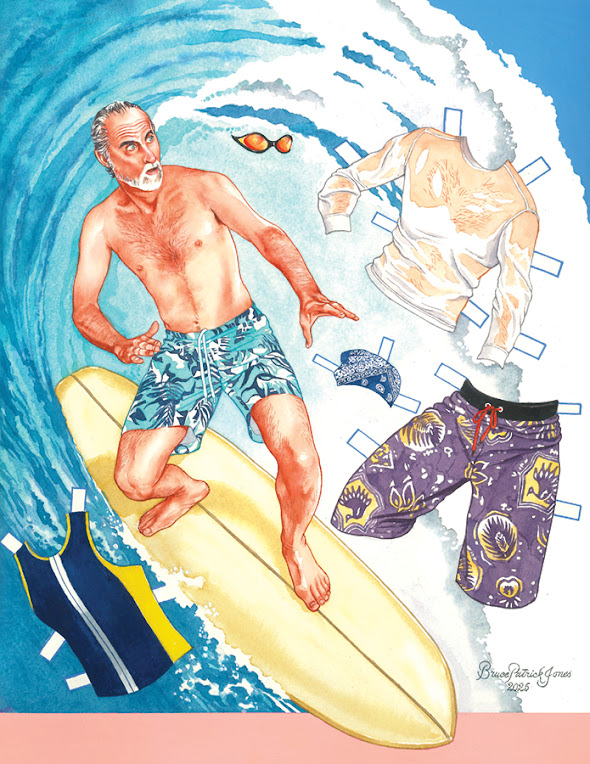
Exceptional paper doll depicting a man surfing and various fashions to dress him in

The Best Paper Doll Ever?

"Alexander Catches the Wave" by Bruce Patrick Jones
for Paperdoll Review Issue 94 (2025)

When Bruce Patrick Jones sent me the preliminary sketch of his surfing paper doll, it was a jaw-dropping moment. It was last May, and I was in the car with my girlfriends following our Morgantown, PA, Paper Doll Luncheon. I passed my phone around to show off Bruce's art, and everyone had the same jaw-dropping response. 

We've all come to expect excellent artistry from Bruce, but this particular paper doll is exceptionally good. First off, we recognized the subject as Bruce's partner, Alexander Best. We were all charmed by Alexander during his first paper doll convention last year, so it was especially fun to see him transformed as a paper doll. No, Alexander is not a surfer, but in the paper doll world there are no limits. Surfing is an unexpected subject for paper dolls. In fact, we found very few to go with an article on the topic for Paperdoll Review Issue 94.

The general theme for this issue is Summer Fun and we planned articles on boating and golfing. Considering my co-editor, Lorna Thomopoulos, is a former surfer who married a champion surfer, she simply had to write about surfing. Any article in our magazine needs to relate to paper dolls, so the hunt was on. I asked Bruce if he had any surfing paper dolls. He did not, but he could certainly draw one! 

Though I was expecting a surfing-themed paper doll from Bruce, I never imagined it would be this dynamic. The handful of paper dolls we did find depict figures standing up, some holding a surfboard, some with a separate surfboard to cut out, along with a few outfits suitable for the beach, swimwear and maybe a wetsuit. So it was especially exciting to see Bruce's paper doll showing a surfer actually surfing! Putting a paper doll in an unusual pose is a challenge in getting proportions right while at the same time being visually pleasing and functional as a paper doll. Bruce hits all of those marks. 

The artistry itself is something to behold. The details are realistic yet not overworked. Notice how Bruce achieved the look of partly wet fabric in the white shirt. The overall design is exceptionally good. The eye goes right into that wave, and we feel the anxiety on Alexander's face. 

Here's the behind-the-scenes scoop: Bruce had Alexander pose in the living room, mimicking the movements of a surfer, and also referred to photographs of Alexander on a vacation, his hair slicked back from the sea. Alexander actually wore those swim trunks in his living room pose. The other clothes are Bruce's own designs based on his research of what "surfer guys" wear. The pattern on the purple shorts comes from one of Bruce's mother's old dresses! Why did Bruce choose Alexander as his model? Simply because he was available and willing... and a cheap model, added Bruce. The art is all done in watercolor, and the pink bar at the bottom is gouache.  

Though I consider this paper doll to be the star of the issue, Bruce himself has a starring role. He happens to be our featured artist with a 6-page article about his work as a commercial artist and his long connection to the paper doll community. If you'd like to dive in to this issue, click here to order. Better yet, subscribe to our specialty magazine—all about paper dolls!


Wednesday, February 26, 2025

Why Paper Dolls? Find out why we love to collect, cut, catalog, create, craft and cherish these remarkable paper playthings. By Marguerite Carrithers


Why Paper Dolls?

by Marguerite Carrithers
Article reprint from Paperdoll Review Issue 88 (2023)

Why paper dolls? It feels too big for any one person to sum up in a thousand or so words, topped with some pithy jokes and wrapped up in a page or two. Paper dolls have been around for centuries; the first we’d recognize were made in Europe during the mid 1700s, though it wasn’t until 1810 that the first manufactured paper doll, Little Fanny by S&J Fuller of London, was made. And they certainly aren’t going anywhere any time soon. 

Advancements in technology haven’t made them irrelevant; if anything, they’ve made them more accessible than ever before. Even in my own life, paper dolls appeared again and again throughout my memories in a way I hadn’t previously realized. My grandmother introduced me to them, and my earliest attempts at drawing were paper dolls. For a brief strange period in fifth grade, I was even selling them to kids at my school. Paper dolls in all their deceptive simplicity keep showing up in magazines, activity books and online, without ever raising an eyebrow or seeming out of place. So what keeps bringing us back?

Maybe it was just something too large or obvious to be answered. But it was a question I kept coming back to, especially as someone lucky enough to have an internship with Paperdoll Review. So I went about trying to answer it as best I could, which is to say by first asking others. I put out the question to artists and collectors within the paper doll community, including several Facebook groups, and the response I received was both absolutely amazing and somewhat overwhelming. People shared some of their favorite memories of paper dolls, their first experiences, and even some paper dolls that were especially notable for them. The paper doll community is one that is exceptionally welcoming and I am very thankful for that fact. And while I was not able to include all of the responses, each was invaluable. With over a hundred responses, patterns quickly began to emerge. Whether they came into people’s lives as children or later, some qualities ensured that paper dolls remain as relevant as ever.

Accessibility
“They are low-tech,” said paper doll artist David Wolfe. “Just a pair of scissors is all you need … It’s important to note that paper dolls are absolutely affordable.” Many of those who discovered paper dolls in their childhood spoke about their accessibility in comparison to fashion dolls or other toys available. Sheryl Knowles shared that in a childhood where moving was common due to family in the Air Force, paper dolls were ideal for being able to carry many in a shoebox. For others, like fashion designer and FIT professor Renaldo Barnette or artist Gregg Nystrom, paper dolls were easier for a young boy interested in fashion and glamour to get his hands on than something like Barbie. Even outside of paper dolls found in magazines, comics or books, anyone can create their own paper dolls so long as they have paper and a pencil. In this way, they also are limitless in the stories that can be created.

Paper Dolls as Tactile Play
Current research shows that children learn through play, especially. But it’s not just them. Play is how we first make sense of the world around us, building nerve connections and  observing cause and effect. It’s how we begin to figure out what we might want our lives to look like and what we think is possible. Play has also been discovered to be useful for adults as well, with it helping maintain problem-solving skills and thinking on your feet. This is even truer when it comes to what is called tactile or sensory play (which might more traditionally just be called play, to further complicate things) where one is physically interacting with an object or the world around them. Don’t get me wrong, as a member of Gen Z I’m grateful that I’ve basically always had modern technology at my disposal but there’s a reason the toy world didn’t go completely virtual like some predicted it might in the ’90s. Physical interaction is how we know we’re connected to the world around us and that we have a place in it. 2020 made this clearer than ever, with people flocking to activities like baking or crafting in the absence of being able to go outside.

Paper dolls are an ideal form of tactile play, combining creativity with a material component. They may be beautiful simply on the page (more on that later), but in use they shine. Teri Pettit points out that “There are other kinds of art toys that were popular in the ’60s and ’70s, like Paint by Number kits, Lite Brite, Spirograph, string art, etc., but for most of them you do the picture creation phase, and then you’re done with it and have to move on. But with paper dolls and paper play scenes, you first create something, and then you have a real toy when you’re done.” Becky Mueller uses paper dolls when tutoring six- year-olds, “They’re a fun way to teach vocabulary like arm, shirt, lace, etc. and the girls get to take the dolls home when they successfully learn to read the words.” Melissa Pepe recalled from her own experience that practicing fine motor skills came easier when her mother gave her paper dolls to cut out.

Paper Dolls as Historical Record
Many paper dolls depict historical periods, with fashion historians like Brenda Sneathen Mattox, Tom Tierney, Norma Lu Meehan, and many others who’ve worked within the paper doll industry. They also function as cultural artifacts of the time they were produced, for better and for worse. They are a portal into the time that created them and sometimes, when created after the fact, a way of acknowledging histories that may not always be as visible. Paper dolls have been tied to everything from celebrities to art movements to the ever-changing world of fashion. “They are iconic in representing styles, culture and fashions from specific decades,” said Jeannine Parent. Unlike a book or documentary, they’re something that can be manipulated and used to let the past and present interact. Any historian will tell you that paper, along with fabric, is the most difficult material to preserve and yet often can yield some of the most information on what culture of the time was like. The work of those who scan and archive paper dolls from the past is incredibly valuable, not only for those who enjoy it now but for those who will one day be studying the world we live in. They also, as pointed out by Marcia Dennis Lickei, can be much more compact to store than vintage textiles.

Paper Dolls as Art Objects
At the end of the day, paper dolls are tiny pieces of art. Even better, they’re art that can be held. Paper doll artist Kwei-lin Lum says “Paper dolls resonate with me as an uncut art form, at their best mysterious arrangements of objects in a two-dimensional space.” Each artist brings their own style to paper dolls, an extension of how they create. Paper dolls can also be easier for artists to mass-produce. I know that I own ones from artists whom I will never be able to afford original work from. “My parents had a book on art history that I perused for hours on end,” says Dawn Kiefer, “ I think the combination of paper dolls and the art history book led to my lifelong interest in art appreciation as well as the evolution of fashion.” For Sylvia Kleindinst, paper dolls led to a career in art education. Whether they’re in a frame, a book, or cut out ready to tell whatever story you can imagine, the same thing which draws us to all forms of art draws us to paper dolls. Humans have the ability to seek out beauty. In some ways it makes us what we are. In art school, much of the first year is devoted to circular conversations on how to define art, but that’s almost beside the point. People will always want to create, whether it’s statues or cave paintings or, yes, paper dolls.

And I think that might be my answer, at least, to “why paper dolls,” since it feels unfair to ask everyone a question without giving my own response. It’s some incredible combination of all of the above. There’s something instinctual about paper dolls. “It’s a ‘heart’ thing,” says Susan Plante Witmeyer. “They tug, remind, comfort, delight.” Paper dolls will remain for the same reason we keep making art or playing, which is to say it’s so a part of us that there may not be any simple reason. Children left to their own devices will find ways to imagine even if just given paper and pencils. No matter what myths we tell about maturity, we’re not going to grow past that.

Marguerite Carrithers is a graduate of the School of the Art Institute of Chicago, and interned for Paperdoll Review in 2021. Her articles have appeared in Paperdoll Review issues #81 and #86.  

Click here to subscribe to our specialty magazine... all about paper dolls!

Title image: Saalfield’s The Little Dressmaker Paper Dolls (1949).

Friday, January 10, 2025

2024 Year in Review from Paperdoll Review - More than 2 Dozen New Books and Marvelous Magazine Issues


New Paper Doll Books

Shown here is just a sampling of the new books we published throughout 2024 covering fashion history, Classic Hollywood, folk costumes, bridal gowns, historic figures, fanciful characters and adorable children. 

Our titles represent a Who's Who among paper doll artists—Eileen Rudisill Miller, Julie Allen Matthews, Brenda Sneathen MattoxAlina Kolluri, Kwei-lin Lum, Sandra Vanderpool, Deanna Williams, Jim Howard, Tom Tierney and Marilyn Henry. Plus we've introduced a few more vintage reproductions including the darling Judy & Jim paper doll book by Hilda Miloche from 1948.

We're delighted to bring two additional artists into our fold—Dan DeSantis and Ralph Hodgdon. Ralph has been self-publishing his paper dolls for decades and he recently turned over a big stack of his original art for us to transform into beautifully published paper doll books. Dan DeSantis is a name that some folks might remember from the 1990s when he was contributing paper dolls to OPDAG's Paper Doll Studio magazine. An artist and fashion designer, he's found his way back to paper dolls. His first book is Cairo Pemberton, an Egyptologist and Socialite. In 2025 we'll publish two more books featuring Cairo's friends Mandaling and Lockie. 

For a behind-the-scenes look at some of these books, visit Julie Allen Matthews' Paper Doll School Blog. Julie has a hand in just about every project we do, including our magazine, which I'll talk about next. 


Though our magazine subscription is quarterly, it takes a little longer than three months to get a new issue out. So I like to say it's a 4-issue subscription to give myself (and our contributors) a little extra time between issues. 

Our first edition of 2024, Issue 90 is a celebration of Hollywood Glamour with features on Ava Gardner (including a dress-a-doll), Brits in Hollywood, Hollywood Sopranos, plus fabric rendering tips, UK greeting cards and more. Issue 91 covers Colonial Fashion, Native American PDs, History of Pockets, Cataloging Paper Dolls and more. Issue 92 has a few wintery themed features including Santa paper dolls, Nativity play sets, Victorian Christmas Traditions and a dress-a-doll. We also cover rare paper dolls from the 1830s, how-tos from vintage books and the 2024 paper doll convention report. Each issue is a visual delight, with a beautiful balance of paper doll art and articles. To keep our magazine in print it's important to keep up our subscription base, so if you're not already a subscriber, I hope you'll give it a try! Click here to subscribe. 

My goal this year is to keep up with my blog! With the assistance of Julie—the queen of project management—I've come up with a monthly plan of things to share throughout the year. Speaking of calendars, I highly recommend Julie's 2025 paper doll calendar called Emma McKay Every Day

Here's to a paperdolly new year!


Thursday, April 25, 2024

New Paper Doll Books Coming in 2024!

What's coming next? That's a question we often hear from eager collectors. So here's a sneak preview of some of the titles we'll be publishing throughout 2024. Several are re-issues of sets that were long ago self-published by the artists. Thanks to our agreements with the artists and their estates—as well as the graphic wizardry of Julie Allen Matthews—we're able to offer a wonderful variety of art and subjects reformatted into collectible paper doll books. These titles include Ladies at Leisure, Art Deco Bride and Lord Robert: The Queen's Favorite by Sandra Vanderpool; and Expressions of Erté and European Folk Costumes Vol. 1 by Deanna Williams

Marilyn Henry's classic star paper dolls are highly desired among collectors, and this fall we'll have her beautiful Barbara Stanwyck book. At the request of Marilyn and her family, we'll be re-issuing some of her out-of-print star books originally issued by B. Shackman. I have the gorgeous original art boards for all of those books, and it's a dream to look through them. Marilyn's Stanwyck portrait was recently featured on the cover of our Paperdoll Review magazine issue #90.

Another classic star book to look forward to is Legendary Film Actresses by Eileen Rudisill "Rudy" Miller, featuring four mega stars of the Golden Age of Hollywood. Rudy will debut the book at the Indianapolis Paper Doll Convention this August, and it will be available on paperdollreview.com around the same time.

Also debuting at the convention is Kwei-lin Lum's Jazz Baby, featuring a fabulous flapper named Babe and her cool and clever wardrobe referencing the Deco lines of the Jazz era with a fun flair from Kwei-lin's imagination. Staying in the same era, Alina Kolluri created a darling wardrobe for seven little dears in Deco Kids. They'll be the cat's pajamas in sailor suits, pretty plaids, fancy frocks and polka dots. 

Keep an eye on paperdollreview.com for these books and more! 

Friday, April 12, 2024

Remembering David Wolfe: Iconic Fashion Illustrator, Fashion Trend Forecaster, Paper Doll Artist and My Best Friend

David Wolfe
David Wolfe 1941-2023

My Amazing Friend David Wolfe
by Jenny Taliadoros

Reprinted from Paperdoll Review issue #87, Spring 2003 (out of print)
Click here for a PDF of the article.

I have often thought of David as the puppet master, pulling the strings of many colorful characters in his grand paper doll show. And I was lucky enough to be cast as his leading lady. Appropriately, David referred to the last 20 years of his life as his third act. Act 1: Leading Fashion Illustrator. Act 2: Top Trend Forecaster. Act 3: Paper Doll Maestro.   

David entered my life early in 2002 when he joined OPDAG, following the advice of Gene Maiden whom he met at the Ken Knutsen auction in Chicago. Right away, David submitted a paper doll for our hat-themed Paper Doll Studio issue #71, and it was obvious I saw something exceptional in his artistic style and fashion flair. His subsequent submissions were just as fabulous—coy Alice in Wonderland for issue #72, marvelous medieval costumes for issue #73, and his Zsa Zsa Gabor landed on the cover of our Vintage TV issue #74. 

We met in real life at the 2004 Providence paper doll convention. It was a costume night, and I looked ridiculous in a dramatic white pantsuit, giant false lashes and a big blonde wig. At that moment did David know our meeting was kismet? As a gifted trend forecaster, he likely did. Soon after, I asked David to join OPDAG’s editorial team. When I called his office in New York, the conversation went like this: “Hi David, this is Jenny Taliadoros from OPDAG and I was wondering if you’d like to…” “Yes!” David said without knowing what I was about to ask. The very next issue, Paper Doll Studio #80, Fall 2004, announced David’s addition to our staff of managing editors. He was also the issue’s featured artist. “Not only do I love collecting and creating paper dolls,” he wrote in his first article, “but I feel that I owe them a debt of gratitude. If it hadn’t been for paper dolls I never would have had the exciting career in fashion that I’ve enjoyed for more than forty years.”

Full page ad in British Vogue.
What was David’s exciting career in fashion? If I had grasped the gravity of it all, I would have been way too intimidated to ask David to work for free on what was then a little black-and-white publication with just 350 subscribers. 

“From Ashtabula to Paris” is how David described his rocket launch from window dresser of a small-town Ohio department store to sketching the latest collections in designer salons across Europe. Working for Carlisle’s Department store throughout much of the 1960s, David became a big fish in a small pond, creating cutting-edge ad campaigns, producing exciting fashion shows, designing innovative window displays, and stocking the racks with fashion-forward merchandise.

On a trip to England in 1968, David showed his portfolio to the advertising director of London’s prestigious retailer, Fortnum & Mason. The response was more than David could have ever imagined. He was asked to leave for Paris that afternoon to sketch Ungaro’s new collection for a series of ads that would appear in British Vogue. For the next decade he traveled to the world’s fashion capitals, drawing thousands of illustrations which appeared in top fashion magazines, newspapers and trade journals. 

Along the way, he became restless to do more than document current fashion. He joined forces with Leigh Rudd, creator of IM International, to spearhead something new—fashion forecasting. As the creative director of IM, David drew on a variety of sources—not just what people were wearing on the street, but what books they were reading, the music they listened to, and the latest developments in science and politics—to predict what people would be craving and wearing next. The IM International Report was published monthly from 1968 to 1988 and was distributed in 16 countries to clients such as Eastman Chemical, DuPont, Harrods, Lord & Taylor, Macy’s, Donna Karan, Ralph Lauren and Calvin Klein. 

In 1992 David brought his innovative approach to The Doneger Group in New York, where his dynamic fashion forecasting presentations were standing-room-only events. His insights were in high demand and he became one of the most quoted authorities in the fashion industry. The National UK described David as “the oracle of fashion trends.”

This sums up our friendship!

It seems like I spoke with David a million times during his Doneger years—David in his Seventh Avenue office overlooking the Macy’s loading dock, me in my basement office in the mountains of Maine. While his work in the fashion biz was still in full swing, David carved out time for paper dolls—drawing them, talking about them, writing about them, and cheerleading the work of other artists. 

It was the mid-2000s. Small paper doll publishers were vanishing and Dover was producing fewer and fewer books. But David could foresee a rebirth and a return to the Golden Age of Paper Dolls. Pulling those puppet strings, David encouraged me to start my own publishing company and he quickly became an integral part of every aspect of my business. David felt like an extension of myself and my work. Ending a phone call I’d say, “We’ll stay in touch constantly … if not more often.” And David would laugh every time.  

Joining David early on were well-known paper doll artists of the time—Marilyn Henry, Tom Tierney, Brenda Sneathen Mattox, Sandra Vanderpool, Judy M Johnson, Charlotte Whatley, Bruce Patrick Jones and Norma Lu Meehan. They all got on board with my fledgling company, Paper Studio Press, providing top-notch work for the modest fees I was able to pay. And David had a hand in every single project. One of his most important contributions was bringing acclaimed fashion illustrator Jim Howard on board. More artists joined the stable and over the years I’ve published more than 175 titles through Paper Studio Press and dozens more under my Paperdoll Review imprint. 

Just a few of the dozens of paper doll books illustrated by David Wolfe.

Puppetmaster David was behind it all. A huge fan of his fellow artists, he was thrilled to choose topics for them, design their books, and write essays to go with their art. And then he’d write the promotional copy! The rebirth of paper dolls was happening right before our very eyes. David alone illustrated more than 50 published paper doll books—including many classic movie stars. His third act now included real star players. Not only did he draw paper dolls of his movie idols, he got to meet some of them, too! When Doris Day sang praises of his work during a treasured phone chat, David thought his life was complete.

His enthusiasm for All Things Paper Doll continued in the pages of OPDAG’s magazine and Paperdoll Review, writing 95 articles covering a wide range of topics relating to fashion, Classic Hollywood, Broadway, royalty, drawing tips and convention reports. 

David LOVED paper doll conventions, which offered a cast of characters who brought him endless joy. Meeting and getting to know these wonderful, quirky, talented, interesting, marvelous people fueled David until the next paper doll gathering. He put the pizzazz in every convention he attended, often running the show as emcee. Everyone I know has had something wonderful to say about David. He gave so freely of himself, of his talents, his humor, his praise, his enthusiasm and his love. And we loved him right back.

Scott Jorgenson, long-time friend of David’s, said the paper doll community brought David a level of happiness and contentment he’d never experienced before. When his health declined from Parkinson’s disease, he kept on creating. When his hands became too shaky to paint, he collaborated with Julie Allen Matthews who’d render and color his sketches. He continued to come up with book designs for artists, such as Alina Kolluri’s recent Teen Scene Paper Dolls. When he could no longer research and write articles, he wrote movie reviews for our little movie club of three—David, Rudy Miller and myself. And when dementia took hold, David’s mixed-up mind put him in glamorous settings, and he’d tell tales of travels and fashion shows and talking to movie stars. He managed to have the Hollywood version of dementia.  

After a fall last October, his health quickly deteriorated. He spent the last six months in a nursing home, his dear husband, Francisco Murillo, looking after him every day. He passed away on Sunday, April 16, 2023, at the age of 82. He is survived by his son Zach and two step-daughters Lynette and Nicole. His daughter Amanda Hallay Heath passed away on January 25, 2023, following a serious illness. Amanda was connected to the fashion industry as a professor, writer and consultant. She presented at our 2017 Philadelphia convention and contributed several articles to our paper doll magazines. 

My life is forever changed because of David. I hope to carry on his legacy through my continued work with paper dolls and my love of the paper doll community. Julie Matthews summed it up well when she said, “I can’t fill his shoes, but I can wear his slippers.” 


Sunday, March 10, 2024

Coloring Princesses of Wales Paper Dolls by Brenda Sneathen Mattox and Julie Allen Matthews

Caroline of Ansbach costume by Brenda Mattox, color by Julie Matthews

Alexandra of Denmark costume by Brenda Mattox, color by Julie Matthews

I'm excited to offer a behind-the-scenes look at our new paper doll book, THE PRINCESSES OF WALES, a glorious collaboration between Brenda Mattox and Julie Allen Matthews. Brenda's linework is exquisite and reminiscent of antique engravings. She illustrated this b&w set back in 2003 and recently brought Julie in to add color and assemble it into a new book for Paperdoll Review. Here are dresses for Caroline of Ansbach and Alexandra of Denmark, along side Julie's colored versions, using Procreate on the iPad Pro. Brenda is thrilled to breathe new life into her old work. Brenda and Julie previously teamed up for VICTORIAN FANCY DRESS PAPER DOLLS, published in 2022.

There have only been ten women who used the title "Princess of Wales" in the last 700 years, and all were unique women of their eras. The title can only be bestowed upon the wife of the heir to the throne of Great Britain. It was originated in the 13th century by King Edward I who succeeded in annexing Wales to England. To placate the Welsh nobles, he offered them their own prince, the king’s son and heir. The future Edward II was created Prince of Wales in 1301. He did not marry until after he became King and sixty years would pass before there was a first Princess of Wales. Costumes in this book represent Joan of Kent (1328-1385), Lady Anne Neville (1456-1485), Catherine of Aragon (1485-1536), Caroline of Ansbach (1683-1737), Augusta of Saxe-Gotha (1719-1772), Caroline of Brunswick (1768-1821),  Alexandra of Denmark (1844-1925), Mary of Teck (1867-1953), Lady Diana Spencer (1961-1997) and Catherine Middleton (b. 1982).

Monday, February 12, 2024

The Day I Went to Paper Doll Heaven by Marilyn Henry


The Day I Went to Paper Doll Heaven
Article from Paperdoll Review magazine issue #10, 1995.

"Now that's eerie," I said to myself when I happened upon an article in an old issue of Paperdoll Review. Back in 1995, in Issue 10, Marilyn Henry wrote an article called "The Day I Went to Paper Doll Heaven." My dear friend and long-time co-editor passed away in 2020, and if there's a Paper Doll Heaven, Marilyn is there in all her glory. The story she wrote in 1995 is a sweet one, about the day she received a treasure-trove of paper dolls from her older brother's friends. Shown above is the article as it appeared in the magazine. And below is the text with full color versions of the paper dolls shown in the article. 

The Day I Went to Paper Doll Heaven
by Marilyn Henry

If we have been collecting long enough, most of us can recall a day when we hit it lucky, when the sun shone on us and we found a cache of wonderful, rare paper dolls to add to our collections, all in one big load. Add to that a nominal price (or even no price!) and you have paper doll heaven!

That day came to me when I was still a little girl, maybe nine or ten years old. My life at that time was completely focused on movies and paper dolls, and one of my greatest joys was going downtown with mother and finding a new movie star paper doll with matching coloring book in the dime store rack. My other greatest joy was going to the movies and seeing those stars and then drawing their costumes when I came home. For me, crayons were the greatest toy ever invented. 

My brother was in college and he had two friends who were dating two sisters. Evidently my brother had mentioned in passing that his little sister was nuts for movies and paper dolls. The sisters were ready to dispose of theirs, so they offered and my brother took me over to their house to pick up my booty. I was excited, but I didn't yet know just what astonishing luck I'd had.

Bob loaded three or four large cardboard boxes into the car and when I got home and went through the first box, I was sure I had died and gone to heaven.

Each set was cut, but oh, so carefully and neatly, and each was in a paper folder placed inside the original covers, with all the accessories tucked into small envelopes. Each doll was perfect, as if it had never been played with at all, thought the bent tabs said otherwise. They were all perfect and complete, bought between 1934 and 1942, and most were sets I didn't have. I hadn't even seen most of them before, being too young in the ’30s. 

Deanna Durbin Paper DollsAnd what pure treasure: every Shirley Temple set printed, including the Masquerade set, the life-size one and the one with all her screen costumes, right up to 1941's New Shirley Temple, Alice Faye, the five doll Gone With the Wind, all the Deanna Durbin sets, the early Sonja Henies, all the Jane Withers sets, Jeanette MacDonald, Joan Carroll, two Gloria Jean sets, Baby Sandy, Carolyn Lee, Queen Holden's Four Starlets and her early Judy Garland, Linda Darnell & Tyrone Power, all the Let's Play House Quints, The Princesses, and many, many more. So many more that my mind boggles to try to remember them after more than fifty years.

 Of course, mixed in with these wonderful movie stars were some "civilian" sets, but since those didn't interest me, I gave them to my best friend and can no longer remember them. I kept a few, but only what struck me at the time as particularly good artwork: the Bride and Groom Military Wedding set and the earlier Double Weddingset, both by Merrill, and a couple of other great Merrill sets such as Navy Scouts and College Style, etc. 


Jane Withers Paper Doll
What, you may be wondering, was in those other boxes? Clippings. Full page portraits of 1930s and early ’40s movie stars from old movie magazines, most in color. Truly the mother of all lucky days, that day!

Article from: Paperdoll Review Magazine Issue #10, 1995.
The magazine is still going strong! To subscribe,
visit paperdollreview.com

Tuesday, September 13, 2022

A Paper Doll Tribute to Queen Elizabeth II

Queen Elizabeth II was a beloved figure for so many of us around the globe. But for my Paperdoll Review co-editor, Lorna Thomopoulos, a Brit herself, the Queen felt like a family member. Lorna's tribute will appear in Paperdoll Review Issue 85, coming out later this fall. 

Our lovely Queen Elizabeth II at Balmoral Castle Paper Doll was created by Julie Allen Matthews for our upcoming magazine issue. Saddened to hear of the Queen's passing, Julie took to her drawing board. She thought it was a natural fit to highlight the tartans of the Royal Family, especially considering she died at her beloved Balmoral Castle. The first is the Balmoral tartan, said to have been designed by Prince Albert and is only worn by the Royal Family. The second is the Green Stewart, designed for King George VI, Queen Elizabeth's father. An icon in every way, she'll be dearly missed.

Remembering Queen Elizabeth II
by Lorna Currie Thomopoulos
for Paperdoll Review magazine issue #85, Fall 2022

A great sadness fell upon the nation when Queen Elizabeth II died (1926-2022). Everyone, monarchist or not, was effected. The country’s Rock and in some ways, everyone’s Granny, was gone. We all knew it was coming but even broadcasters had watery eyes and cracked voices. 

My earliest “memory” of Queen Elizabeth II is being held in my mother’s arms in 1947 as she, then still a princess, drove down a Durban street in an open-topped car. Actually I do not remember it as I was only one month old but I like knowing I was there. My next sighting was 28 years later as I joined the crowds to see the Queen “Trooping the Colour” in London. She passed by sitting side saddle on her horse, smaller than I could have imagined, resplendent in a bright red jacket and matching lipstick.

The third time was at the theatre where she glided by in a fairy-tale evening gown and diamonds, one in particular twinkling throughout the performance. Absolutely fabulous.

Her sense of duty, sharp mind, humour, humanity and acute constitutional understanding has been acknowledged by everyone.

Aged just 21, Her Majesty declared that she would devote her whole life to the service of her people. “A fair and youthful figure, princess, wife and mother, is the heir to all our traditions and glories,” as an entranced Sir Winston Churchill so poetically put it on her Coronation.

Elizabeth’s extraordinary reign, spanning more than seven decades—longer than any other Monarch in British history—selflessly demonstrated this steadfast commitment to public service.

Always conducted in sartorial elegance—she was Great Britain’s greatest advertisement and the most famous woman on earth.

We are going to miss the gold dust she sprinkled on everything.